What Are The Pattern Skill Levels?
With yarn companies that produce patterns, there is usually a pattern skill level bar or description of beginner, easy, intermediate and experienced.
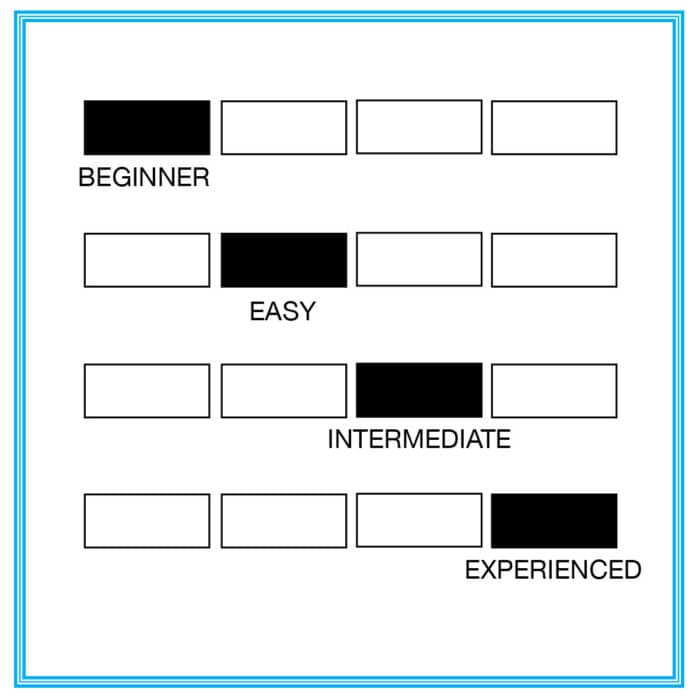
Many crocheters use this bar as an indicator right off the bat to determine if they can do the pattern without actually reading it. Though I must admit, I have missed out on crocheting some great projects with fear that I couldn't do something.
What Does Frogging Mean?
In the world of crochet, you will some of us saying we are frogging our work. It means we are ripping out our stitches. So the frog goes Ribbit Ribbit but us crocheters go rip it rip it... To rip out our stitches. Get it!?
More Tips
- How to Figure out the Multiples of a Crochet Pattern + Tutorial
- Learn How To Read Crochet Patterns + Tutorial
- Free Crochet Workshop for Beginners + Tutorial
- Crochet Sky Watch Blanket + Free Downloadable Worksheet
Sometimes, we want something simple even though we can do something more challenging. Each one of these increments has a meaning behind it, which is used to determine the skill level. Though I must admit, I have seen patterns marked easy and I have had a conniption trying to figure it out. I have added in my own words what the levels mean to me.
Pattern Levels
As described by the Yarn Craft Council of America.
Beginner, 1 Increment Filled In
- Projects intended for first-time crocheters using basic stitches and minimal shaping.
- In my own words, these are simple afghans and dishcloths. Most likely not changing colours or doing anything fancy.
- Excellent pattern for new crocheters to build their skills on. Practice makes perfect.
- For experienced crocheters, you can probably watch TV and crochet at the same time without missing a stitch. A non-brainer as your hands will do the work without much thought.
Easy, 2 Increments Filled In
- Projects using basic stitches, repetitive stitches, colour changes and simple shaping and finishing.
- In my own words, afghans or projects where there are stitches that repeat to create textures based on the stitches have a unique look. There's not a lot of complex shaping or anything that requires you to throw your hook across the room in frustration.
- Experienced crocheters and glance up and down from the TV but have to concentrate once in a while. You don't have to obsessively count but your family members may see you mumble and ask you to repeat.
Intermediate, 3 Increments Filled In
- Projects using a variety of different stitches or techniques such as basic lace patterns or colour patterns with mid-level shaping and finishing.
- In my own words, afghan or projects where you are playing with multiples of different stitches to create interesting effects with stitches. Shaping requiring closer attention such as clothing and more.
- Better know how to count in your head and hopefully not getting tired of counting to same number.
- If the project is too big, you might get tired of it depending how badly you want to finish it.
Experienced, 4 Increments Filled In
- Projects with intricate stitch patterns, techniques, and dimensions such as non-repeating patterns, multi-colour techniques, threads, small hooks, detailed shapes and fine attention to finishing.
- In my own words, has the potential for the hook to go flying across the room if you are not paying attention to the pattern. The pattern will require a lot more concentration and a lot less conversation.
- Your tongue may hang out of your mouth as you crochet as you are concentrating so hard. You have the potential to have sudden fits of rage if something interrupts, better warn anyone in your surroundings first.
- You are better off to crochet on your own and no one gets hurt.
Sarah Schweikert says
These descriptions are perfect. Thank you.
SAZ says
Thank you for this very informative post, and for all of your other posts & patterns. I recently tried crocheting sweaters and I do not agree with the skill level ratings on these particular patterns. For example, a sweater I'm working on right now is mostly SC. So for that reason it seems to be an easy level. However, piecing together the different parts of the sweater and shaping the armholes and neck hole is definitely not easy. Trying to make sense of the illustrations of the different components can be frustrating. There are a lot of assumptions built in to the written pattern. I wanted to give up many times, but I'm trying not to think about it too much and just take it row by row. In my opinion, this is intermediate at least. Many thanks and blessings!
Jenny says
I'm an experienced crocheter embarking on pattern writing for the first time, and I just loved these descriptions! Thank you and well done 🙂 Stay safe and happy!